
Yoga has become a popular way to stay active, improve flexibility, work on breathing and manage stress. And that is a good thing.
But if you have a heart or lung condition, you may wonder: "If I am already doing yoga regularly, do I really need specialised physiotherapy?"
Sometimes yoga may be enough for general activity. But yoga and cardiopulmonary rehabilitation are not the same thing. They can complement each other — but they have different purposes.
Yoga is not the problem
Yoga can include:
- Movement and stretching
- Balance work
- Breathing practices
- Relaxation
- Mindfulness
- Strengthening through certain postures
Research has found potential benefits of yoga in people with several chronic conditions. So the question is not: "Yoga or physiotherapy — which one is better?" A better question is: "What does my condition require from my exercise programme?"
What is different about specialised cardiopulmonary rehabilitation?
Cardiopulmonary rehabilitation starts with your condition and your current capacity. Before deciding how much you should exercise, a cardiopulmonary physiotherapist may look at:
- Your diagnosis and medical history
- Current symptoms
- Exercise tolerance
- Heart-rate response
- Blood-pressure response
- Oxygen saturation, when relevant
- Breathlessness and fatigue
- Muscle strength
- Functional ability
- Your medications and other clinical factors
The exercise programme can then be adjusted according to what is found. This is particularly important because two people with the same diagnosis may not have the same exercise capacity.
Yoga may help you move. Rehabilitation asks how much you should do.
Imagine two people with COPD. Both attend the same yoga class. Both can perform the same basic movements. But one person may become breathless after five minutes of activity, while the other may comfortably continue for much longer.
Their rehabilitation needs are therefore different. A cardiopulmonary rehabilitation programme can use assessment and monitoring to determine where to start, how hard to work and how to progress. The same principle applies to cardiac rehabilitation.
What does specialised rehabilitation add?
Depending on your condition, rehabilitation may include several different components.
- Aerobic training. Walking, cycling or other appropriate activities can be progressed to improve exercise capacity, with monitoring and targets set from a tailored prescription.
- Strength and resistance training. Weak muscles can make everyday activities harder and increase the effort required for movement. Strength and resistance training has been shown to help muscles use oxygen more effectively.
- Breathing techniques. These may be useful when breathing pattern, dyspnoea or respiratory muscle function needs specific attention. Not every breathing exercise is meant for everyone.
- Functional training. The goal is not simply to exercise. It is to make walking, climbing stairs, bathing, shopping and daily life easier.
- Monitoring and progression. Your response to exercise can help determine whether the programme should be progressed or modified.
- Education. Understanding breathlessness, pacing, energy conservation, symptoms and safe exercise can be an important part of rehabilitation.
Can yoga replace rehabilitation?
Not necessarily. For someone with a diagnosed cardiac or respiratory condition — particularly when there is reduced exercise capacity, significant breathlessness, recent hospitalisation or a recent cardiac event — yoga should not automatically be considered a substitute for a structured rehabilitation programme.
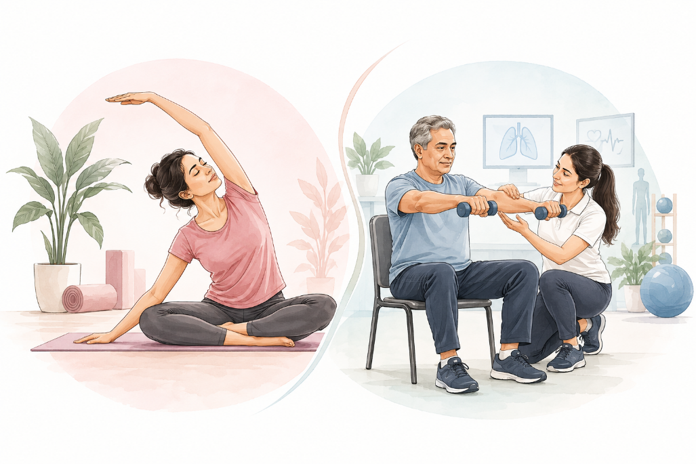
At the same time, this does not mean that yoga needs to be stopped. In many people, yoga may fit well alongside rehabilitation.
Think of it this way: yoga can be one part of your physical activity. Cardiopulmonary rehabilitation is a structured clinical programme built around your condition and your capacity.
Questions a yoga class may not answer
- Why do I still get breathless?
- Why do my legs tire quickly?
- Why can't I walk as far as I used to?
- Is my exercise intensity appropriate?
- Does my oxygen level change when I exercise?
- Am I progressing safely?
- Can I do more than I am currently doing?
If you are asking these questions, an assessment can provide information that a general yoga class may not.
Sometimes specialised rehabilitation is not needed right now
That is important too. A good rehabilitation assessment should not be about convincing everyone to enrol in a programme. It should help determine what you need.
Sometimes the answer may be:
- Continue your current activity
- Modify your exercise
- Add strength training
- Increase aerobic activity
- Work on breathing
- Undergo a structured rehabilitation programme
- Or discuss another issue with your physician
Rehabilitation should be prescribed according to need — not simply according to diagnosis.
The bottom line
Keep doing yoga if it works well for you. But remember that yoga and cardiopulmonary rehabilitation have different roles.
Yoga can support movement, flexibility, breathing, relaxation and overall wellbeing. Specialised cardiopulmonary rehabilitation adds clinical assessment, individualised exercise prescription, monitoring and structured progression for people who need it.
You do not have to choose one against the other. For some people, the best approach may be yoga, plus appropriate exercise, plus specialised rehabilitation when indicated. The goal is not simply to exercise. The goal is to help you exercise safely, progress appropriately and return to the life you want to live.
A simple way to remember it
Yoga asks: "How can I move and feel better?" Cardiopulmonary rehabilitation asks: "Given my heart or lung condition, what does my body need — and how should I progress?"
Sometimes you need one. Sometimes both. The first step is knowing which one you actually need.
Evidence behind this article
- A 2026 systematic review and meta-analysis of yoga as an adjunct to cardiac rehabilitation in coronary artery disease found improvements in quality of life and modest psychological benefits, while noting heterogeneity and the need for better-standardised research.
- A systematic review and meta-analysis of yoga in COPD found improvements in exercise capacity and some pulmonary outcomes, particularly with breathing-focused interventions.
- The 2026 ESC guideline defines cardiac rehabilitation as a multidisciplinary, patient-centred and medically supervised intervention with individualised exercise prescription and outcome assessment.
- The ATS pulmonary rehabilitation guideline supports pulmonary rehabilitation and emphasises clinical assessment, shared decision-making and personalised care.
Clinical references
Primary professional guidance used to support the clinical context in this article.
- Efficacy of yoga as an adjunct in cardiac rehabilitation in coronary artery disease patients: A systematic review and meta-analysisJournal of Education and Health Promotion, 2026. DOI: 10.4103/jehp.jehp_449_26
- The risks and benefits of yoga for patients with chronic obstructive pulmonary disease: a systematic review and meta-analysisClinical Rehabilitation. DOI: 10.1177/0269215519860551
- 2026 ESC Guidelines on Cardiac RehabilitationEuropean Society of Cardiology. European Heart Journal, 2026. DOI: 10.1093/eurheartj/ehag099
- Pulmonary Rehabilitation for Adults with Chronic Respiratory Disease: An Official American Thoracic Society Clinical Practice GuidelineAmerican Thoracic Society